

Dry Riser Servicing & Inspections
NEW - Book your appointment on our live appointment planner
Comprehensive Dry Riser Testing & Service Contracts
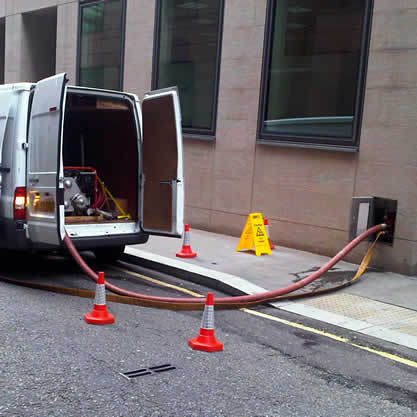
All buildings which have a Wet or Dry Riser must comply with the standards BS5306 and BS9990/2015.
Dry riser maintenance / servicing has a requirement for 2 visits per year.
A visual inspection is recommended every 6 months and a hydraulic pressure test every 12 months. Failure to do so may invalidate your insurance. We work throughout London and across the UK. Contact
us today for expert Wet and Dry Riser services and maintenance.
Durcan UK Dry Risers have service agreements in place covering numerous prestigious sites across the nation including numerous care homes, residential dwellings and commercial buildings. We work for both end users and sub-contractors for other fire hydrant service companies, Fire Protection Companies, Facilities Management Companies alike. Our reputation for a cost effective, concise and professional service is reflected in the growth of our service base month after month. We pride ourselves on continuity of custom and all our staff are directly employed and not commission based like many of our competitors. Hence, all our customers find we offer a professional service and an honest appraisal in the eventuality we find any faults.
Our 18 point dry riser service is second to none, add in our 24/7 365 emergency call out service we drive to be the number 1 provider within the
industry.
Call us today on 0800 77 20206 or email info@durcans.co.uk for a quotation
6 Month Visual Inspection Consists Of Checking The Following -
- Exercise all valves and leave them secured in the closed position (checking strap and lock if required)
- All outlet washers
- For damaged and missing blank caps and chains
- That all hand wheels and nuts are undamaged and intact
- Landing outlet valves open freely and are undamaged
- The inlet cabinet and do for corrosion
- The inlet breaching valve springs and rubbers are free moving and in good condition
- The inlet/outlet cabinet glass
- All required sinage is present and correct
Annual Pressure Testing
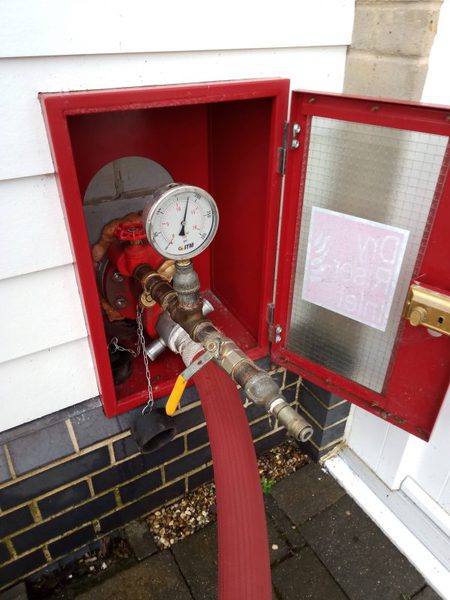
Dry Risers - An annual pressure test entails connecting the inlet to a pump
and water supply. The system is then completely charged with water to a pressure of 12 bar, measured at inlet for a period of at least 15 minutes. During this period an inspection is made to ensure
that there is no leakage of water at any of the joints or landing valves. Once the pressure test is completed the system must be drained so that it is left ready for immediate use. In the event of
the system failing we are able to carry out dry riser tests using air to locate the origin of any leaks without causing any water damage, once the repair is completed we could carry out a full dry
riser pressure test using water inline with British Standards. Dry rise services are an essential requirement to ensure your building is compliant for fire safety.
Wet Risers - For Wet Riser Sytems there are additional checks, on cleanliness of storage tanks, booster pumps and associated mechanical and electrical equipment.
Riser Maintenance & Remedial Repairs -
- Replacing outlet washers
- Repair or replace valves (replace lock and strap if necessary)
- Replace blank caps and chains
- Repair or replace hand wheel nuts
- Repair or replace landing outlets
- Replace the inlet cabinet and door
- Repair the inlet breeching valve/s springs (replace rubbers as necessary)
- Replace inlet/outlet cabinet glass
- Supply dry riser sinage to all floors if required
What is Dry Riser Servicing?
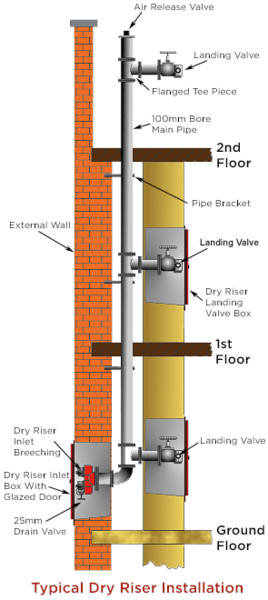
A Dry Riser is a network of pipes running up inside of taller buildings (or ones with restricted access) to enable the fire brigade to pump water to areas within the building when tackling fires high up.
The buildings Responsible Person (or RP) is legally required to ensure the system is maintained to BS 9990:2006 code of practice which means a full annual pressure test plus a six monthly visual check for dry risers in buildings over 18 metres but below 60 metres (anything over 60 metres or 18 stories must have wet risers).
At Durcan Services we pride ourselves on servicing equipment to the highest standard. Our competent, qualified and DBS (CRB) checked engineers can service a variety of dry riser systems and ensure everything is working as it should.
What locations do we cover for Dry Riser Servicing & Dry Riser Repairs?
We cover most areas of England for dry riser work, we have vans most days visiting cities across the south in areas such as London, Cambdrigeshire, Hertfordshire, Essex, Buckinghamshire, Suffolk, Norfolk, Leicestershire, Lincoln, Kent, Buckinghamshire, Surrey, Bedfordshire, Northamptonshire, Nottinghamshire and Middlesex.
Who Is Responsible For Dry Riser Testing?
It is usualy the building landlord / owner who is responsible for ensuring the dry riser within a building is correctly maintained. Durcan Services carried out dry riser work for all types of customers including councils, local authorities, landlords, commercial operatations, distribution centres, car parks and shopping centres.
Our Dry Riser Testing Service

Please feel free to download our guide which highlights what is involved within a dry riser test
Dry-Riser-Servicing-Guide.pdf
Adobe Acrobat document [460.0 KB]
Our London Dry Riser Testing Service
Dry Riser Servicing Across Greater London
Mention boroughs individually:
We regularly service systems across:
- Canary Wharf
- Westminster
- Croydon
- Camden
- Hackney
- Southwark
- Tower Hamlets
- and all surrounding boroughs.
Durcan Services provide expert dry riser servicing, annual pressure testing, remedial repairs and compliance certification across London for managing agents, councils, FM companies, landlords and high-rise residential buildings.
✔ Constructionline Silver accredited
✔ Over 4,500 compliance jobs completed annually
✔ 24/7 emergency callout
✔ Same-visit repairs available
✔ Fully insured specialist engineers
✔ Digital certification
Common Dry Riser Defects Found in London Buildings
- Corroded landing valves
- Damaged inlet boxes
- Missing caps/chains
- Failed pressure retention
- Water ingress
- Incorrect signage
- Tampered outlets
- Mechanical damage
Dry Riser FAQ's
When Is A Dry Riser Required?
Dry risers are typically required in buildings where the top floor is between 18 and 50 metres above the fire brigade access level, or in structures with floors more
than 10 metres below ground level. They provide firefighters with immediate access to water on every floor without dragging heavy hoses up stairwells.
The requirement for installing and designing dry risers is dictated by Approved Document B (Fire Safety) of the Building Regulations and regulated by the BS 9990:2015 code of practice.
Specific criteria include:
Building Height: Mandatory in buildings where the highest floor is above 18m
Below Ground: Required for any building with floor levels more than 10m below ground.
Access Requirements: The external inlet connector must be positioned within 18m of a fire appliance access point.
Distance Constraints: Outlets must be available on each floor, and no part of a floor should be more than60m from an outlet valve.
How Does A Dry Riser Work?
A dry riser is a system of empty pipes built into a building that firefighters use to quickly access water during an emergency. Instead of dragging heavy hoses up stairwells, firefighters connect
their fire engine to an external ground-level inlet and pump water vertically through the building to the required floor.
The system operates in a few clear, straightforward steps:
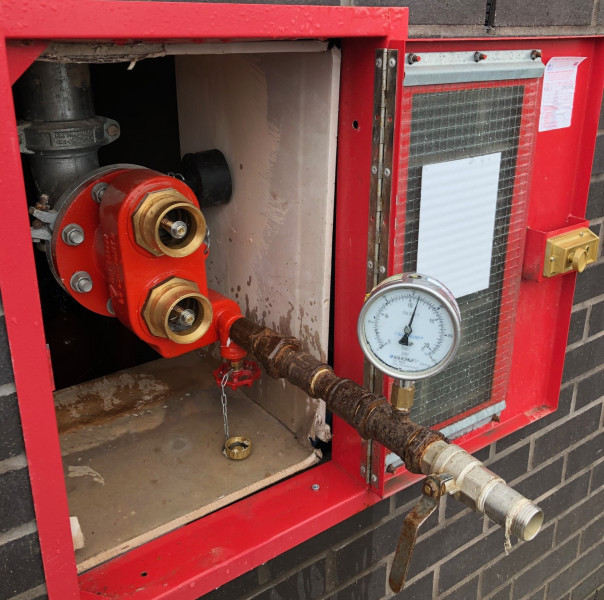
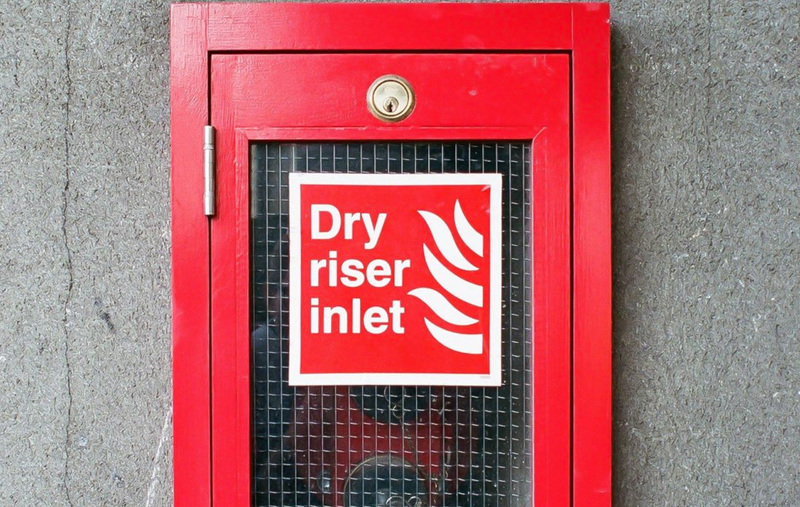
1. The Ground-Level Inlet on the outside of the building (usually near the main entrance), there is a secure, red-glass-fronted cabinet known as the inlet breeching. Firefighters attach hoses from
their fire engine (which is often connected to a nearby fire hydrant) to this inlet valve.
2. Pumping and Pressurisation - Because the pipes remain completely empty (or "dry") when not in use, the fire engine's powerful pumps must force the water up the vertical pipework.The system is
fitted with air release valves at the top, which let trapped air escape so the water can flow smoothly and consistently without creating dangerous blockages or pressure drops.
3. Outlets on Upper Floors - As the water rushes up the main vertical pipe, it reaches horizontal branches on each floor called landing valves (or outlets). Firefighters carry a much shorter, lighter
hose to the floor nearest the fire and connect it directly to these landing valves to extinguish the flames.
How Do You Test A Dry Riser System?
Testing a dry riser involves a visual inspection and a hydraulic (water) pressure test. The system is pressurized to 12 bar (175 psi) and must hold for 15 minutes to prove it is leak-free and capable
of operating under emergency firefighting demands. Dry riser testing must be performed by competent, certified fire safety professionals in accordance with standards like BS 9990.
The process breaks down into the following key phases:
1. Initial Visual Inspection - Before applying pressure, engineers inspect all external and internal components to prevent flooding and ensure basic functionality:
Cabinets & Signage: Check inlet and outlet cabinet doors, hinges, locks, and break-glass panels. Verify that instruction signs are clear and legible.
Valves & Seals: Ensure that landing valves (outlets) open and close smoothly, and replace any degraded rubber washers.
Tamper Devices: Confirm that all padlocks and straps on inlet valves are intact.
2. Hydraulic Pressure Test (Wet Test) - The wet test requires two engineers communicating via radio:
Filling: Attach a water pump to the inlet breeching valve on the ground floor after checking all outlets are closed.
Pressurisation: Allow the pump to gradually build system pressure up to 12 bar.
Monitoring: Maintain this 12 bar pressure for a minimum of 15 minutes. Engineers will check every valve and joint for leaks, pressure drops, or weeping.
3. Draining: The entire system must be fully drained after the test to keep the riser "dry" and prevent pipe corrosion or winter freezing.
4. Certification & Frequency - Every 6 Months: A routine visual inspection is required. Every 12 Months: A full annual pressure and flow test is a legal requirement. Documentation: Following a
successful test, the engineer will issue a Certificate of Compliance, which building managers must retain for fire authorities and insurance audits
What Is The Difference Between A Dry and Wet Riser?
Both wet and dry risers supply water to outlet valves on floors throughout the building for firefighting. The core difference is that dry risers are empty pipes that firefighters must pump water into
from the ground, while wet risers are permanently connected to a water supply and pressurised. Dry risers are typically fitted buildings up to 50m height, wet risers are usually fitted to buildings
50m or greater.
What Is The British Standard For Dry Risers?
British Standard BS 9990:2015 is the code of practice governing the design, installation, testing, and maintenance of dry risers in the UK. It outlines the essential requirements to ensure
firefighters have an immediate, safe water supply during an emergency.
For more information on how we can help install, repair or maintain your property, call us today on 0800 77 20206 or email info@durcans.co.uk
We offer a no obligation assessment and quotation.
Our Location
Durcan Services LTD, Unit 3 Horseshoe Yard, Crowland
Peterborough
PE6 0BJ
Locations
Areas Durcan Services Cover - Click here
Contact Us
0800 7720206 0800 7720206
Social Media

 Print
Sitemap
Print
Sitemap
© Durcan Services Limited 2024 Contact info@durcans.co.uk or call 0800 77 20206 for more information. Privacy Policy Cookie Policy